Huawei Watch Fit 5: The Smartwatch That Actually Tracks Your Tennis Game
Growing up, my relationship with technology was defined by whatever phone was in my pocket.
It started with a brick‑like Nokia, the kind you could drop on concrete and pick back up without a scratch, and slowly evolved through the early touchscreen era ushered in by the first iPhone. Fewer buttons, more glass, and an entire industry scrambling to keep up.
Around 2015, while walking through an electronics store in Australia, I stopped in front of a Huawei Ascend Mate 7. My instinct at the time was scepticism. Like many people, I had grown up equating “made in China” with disposable, cheaply made goods that wouldn’t survive the year. Back then, that impression wasn’t entirely without basis. The safer bet, the conventional wisdom went, was an iPhone. You knew what you were getting.
Fast forward to 2026 and Huawei has spent the better part of a decade proving that conventional wisdom wrong. Despite operating under significant international restrictions, the company has quietly built one of the most cohesive technology ecosystems in the world: phones, laptops, tablets, and wearables that compete on build quality, battery life, and increasingly on features larger rivals haven’t thought to prioritise. Their latest move is a case in point.
A Company Operating in Constrained Conditions
To understand what makes Huawei’s continued innovation remarkable, you need to understand the environment they are working in. In 2019, the US Department of Commerce added Huawei to its Entity List, citing national security concerns and allegations of financial fraud and sanctions violations. The consequences were sweeping. Google suspended Huawei’s access to Android updates and the Play Store, UK chip designer ARM cut ties with the company, and retailers and carriers across multiple markets stepped back from the brand. A company that had been on a trajectory to become the world’s largest smartphone manufacturer found itself effectively locked out of Western supply chains overnight.
The US ban remains in effect. There is no Huawei smartphone launch in America. No Watch Fit 5 on the shelves at Best Buy.
Rather than collapsing under that pressure, Huawei responded by building its own. HarmonyOS replaced Android across its device lineup. AppGallery, Huawei’s own app marketplace, became the alternative to the Play Store. Outside of China, it is a more limited ecosystem—the app library doesn’t match what Google’s platform offers—but the hardware underneath has continued to mature, and the health and fitness software Huawei has developed in‑house has reached a level that deserves serious attention.
The Watch Fit 5 and the Tennix Moment
On April 29, 2026, Huawei released the Watch Fit 5 series in China. The global launch followed on May 7 in Bangkok, with regional rollouts continuing through May. The standard model is priced at £159.99 in the UK; the Pro sits at £249.99. Neither is available in the United States.
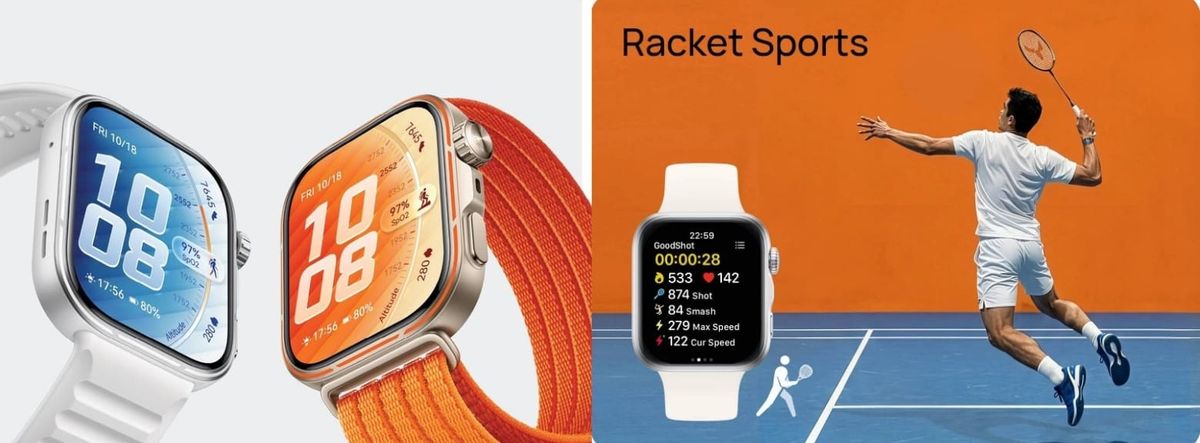
The headline feature across the series for racket sports fans is Tennix, a dedicated tennis tracking app that does something no mainstream smartwatch has managed to do convincingly: count your actual shots. Forehand count, backhand count, total swings, longest rally—all tracked in real time from your wrist during a match or practice session, syncing back to the Huawei Health app when you’re done.
This is not incremental. For years, wearables in a tennis context meant heart rate monitoring and a session timer. You knew how long you played and roughly how many calories you burned. The actual tennis—the mechanics of the session, the distribution of shot types, the rhythm of rallies—was invisible to the device on your wrist. Tennix changes that, and it is worth pausing on how significant a step that is for anyone who takes their game seriously.
Huawei didn’t build Tennix in isolation. It sits alongside PickleX for pickleball and Goodshot for badminton as part of a full racket sports suite, a deliberate strategic play toward a sports‑lifestyle demographic that Apple Watch and Garmin have largely owned in the markets Huawei can actually reach. The Watch Fit 5 Pro extends further into elite outdoor sports territory, adding trail running navigation, free diving support to 40 metres, and access to over 17,000 golf course maps globally. But it is the racket sports tracking that represents the most genuinely novel territory.
No other major smartwatch manufacturer currently offers shot‑type differentiation in tennis at this level. That is a real competitive advantage, and Huawei is smart to be building identity around it.
What It Means for the Sport
From a business and brand perspective, the tennis play makes sense. The sport skews affluent, internationally mobile, and technology‑curious—exactly the consumer Huawei is targeting in the markets where it can sell freely: Southeast Asia, the UK, the Middle East, and parts of Europe. Pairing a well‑priced, premium‑looking wearable with genuine tennis intelligence is a smarter brand positioning move than another cycling metric or another golf handicap calculator.
The broader question is whether tour‑level tennis takes notice, and the timing here is worth noting. Professional tennis is in the middle of a live debate about exactly this technology. The ATP permitted wearables during match play in 2024, the WTA did so in 2021, and the ITF formally approved WHOOP devices in late 2025, provided haptic feedback is disabled. But the Grand Slams, which govern themselves independently, still ban them. That contradiction erupted publicly at the 2026 Australian Open when Alcaraz, Sabalenka, and Sinner were all instructed to remove their WHOOP bands ahead of matches despite having received ITF clearance. The policy is unsettled, the conversation is ongoing, and wearable technology is sitting right at the centre of it.
In that context, a smartwatch that can differentiate forehands from backhands and track rally length in real time is not a novelty. It is exactly the kind of tool the sport is working out how to integrate. If coaches and performance teams start pulling Tennix data into practice session analysis, Huawei earns credibility in tennis that no amount of banner advertising can buy.
The Watch Fit 5 series is available now in most markets outside the United States. And Huawei—if your PR team happens to be reading, the Watch Fit 5 would make a fine addition to the reporting kit. Happy to put Tennix through its paces and report back.
Jake Scudder
Journalist - topics of tennis
I've since put the Watch Fit 5 Pro to a proper test on the padel court. You can read how the Tennix tracking held up in Testing Tennix for Padel: Watch Fit 5 Pro Review.