I Took the Huawei Watch Fit 5 Pro onto a Padel Court. Here's What the Numbers Said.
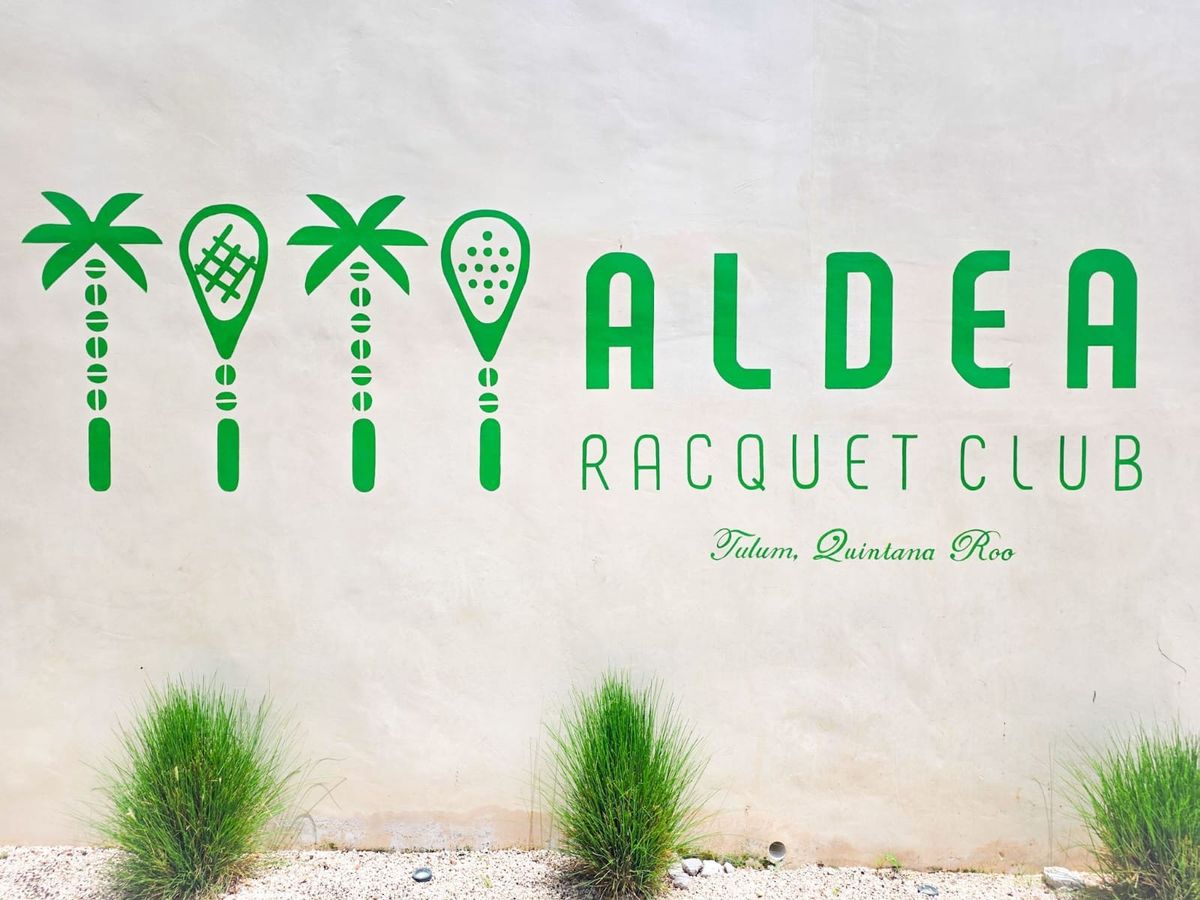
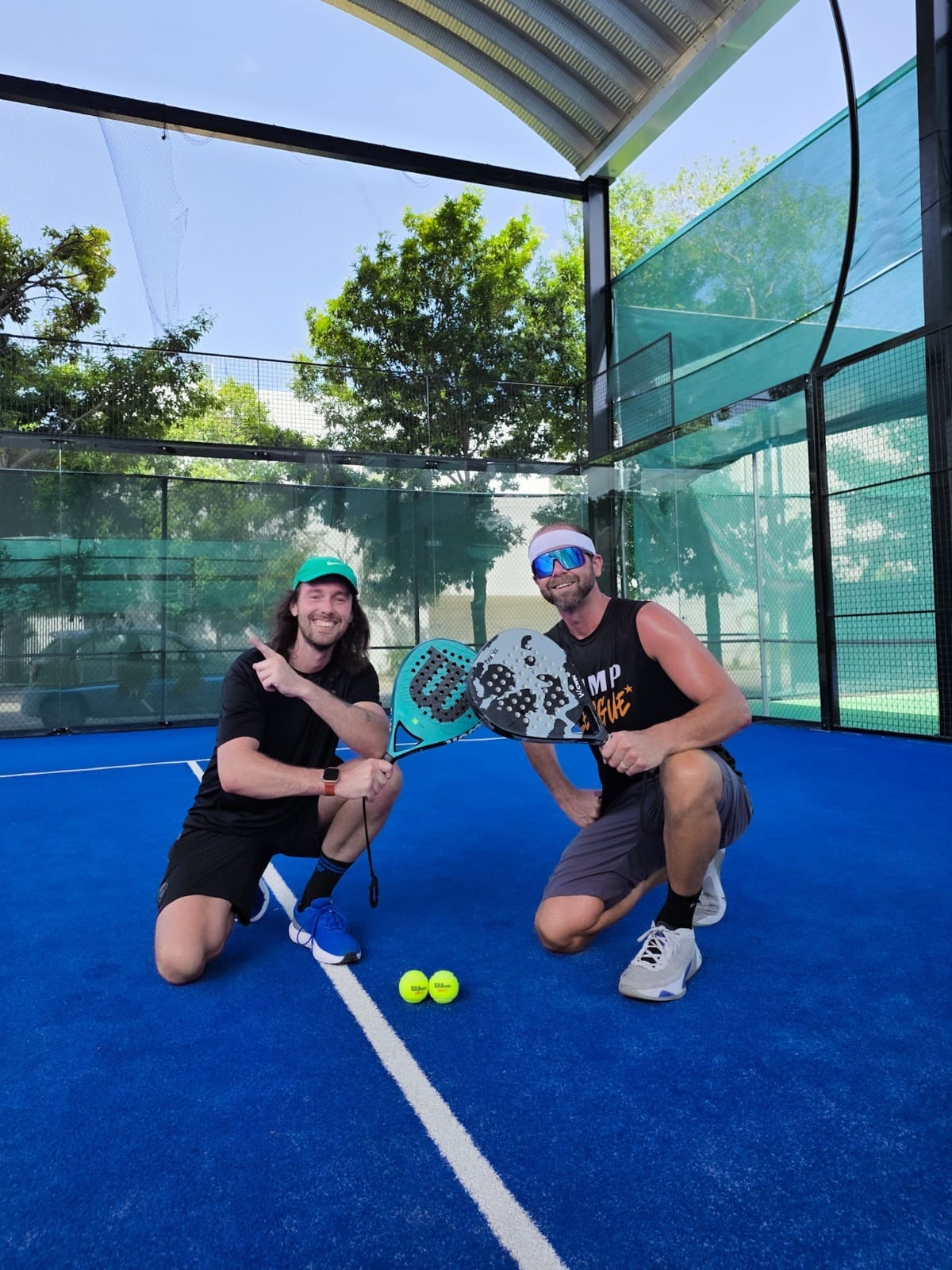
When I wrote about the Huawei Watch Fit 5 and the Tennix app a few weeks back, the focus was on how the technology worked and what it promised for tennis players, rather than a hands-on test. Fair enough, given the name. But Tennix covers racquet sports more broadly than the name suggests, and padel is the one growing fastest around me here in Mexico. So, this week I actually put the Watch Fit 5 Pro on and took it to Aldea Racquet Club in Tulum, my first real test of the sensor tracking in play, to see how it handled a completely different rhythm of game to tennis.
Why Padel is the Real Test
Padel is not slow tennis. The court is smaller, the ball stays low, and the exchanges are quicker and more reactive, with far less time between shots to reset your swing. If a wearable's shot detection is only tuned to a tennis stroke, padel is where that gets exposed fast.
Huawei clearly built for this. Padel sits as its own dedicated activity mode on the watch, alongside Tennis, Badminton, Squash and Table Tennis, rather than being folded into a general racquet sport setting. That distinction matters. It suggests the sensors are calibrated for padel's shorter, flatter swing pattern specifically, not just repurposing tennis data and hoping it translates.
Setting up the Test
I played one-on-one with a mate rather than doubles, purely so I'd rack up as many forehands and backhands as possible in a single hour and get a cleaner read on the shot data. We also agreed beforehand to manually count the longest rally of the match ourselves, saved until near the end, specifically to check the watch's number against ours.
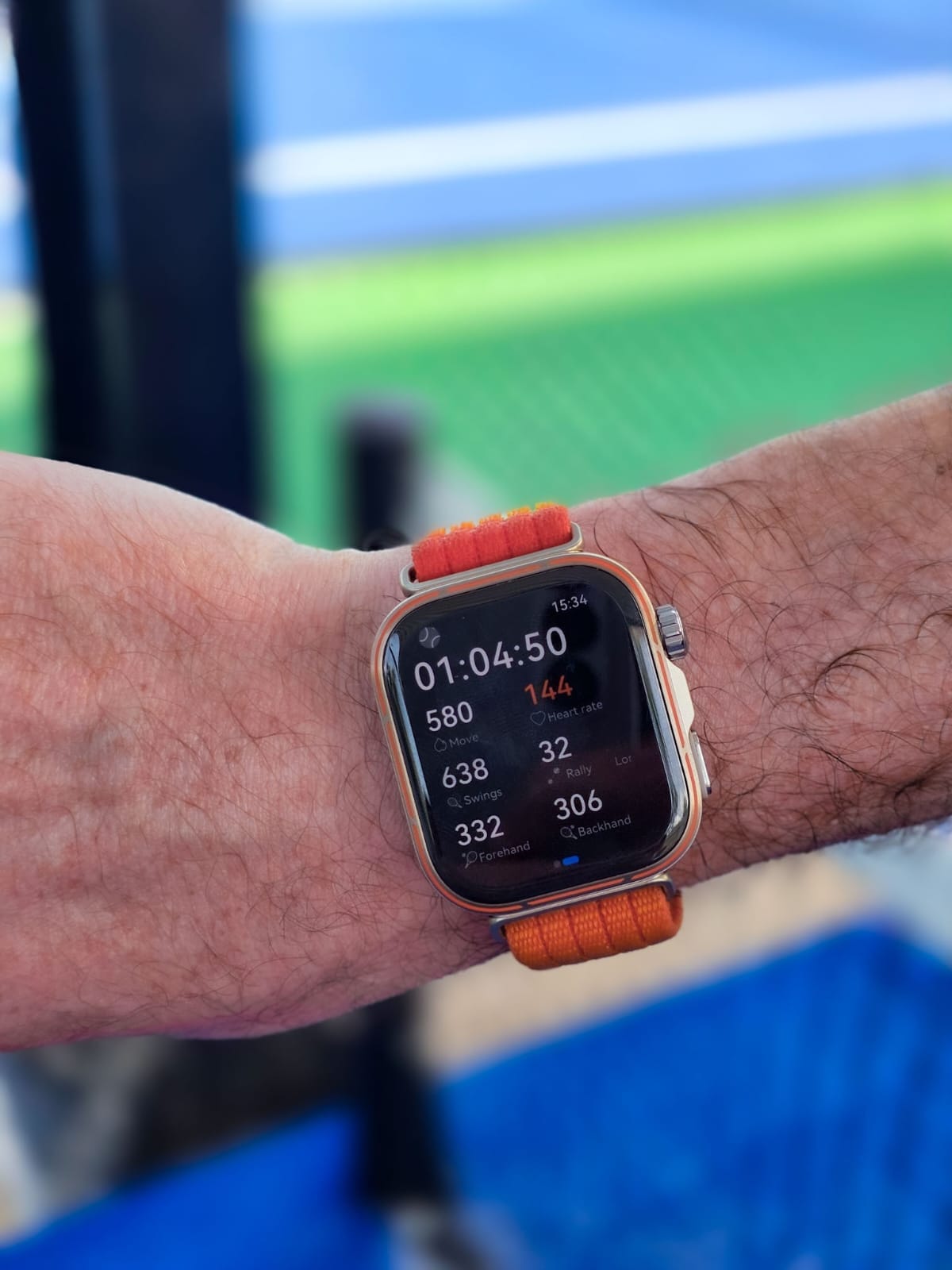
Comfort wasn't something I had to think about once the session started. The velcro strap held the watch securely through an hour of lateral movement and quick direction changes, and the screen stayed easy to check between points for a live shot count and heart rate.
The Numbers
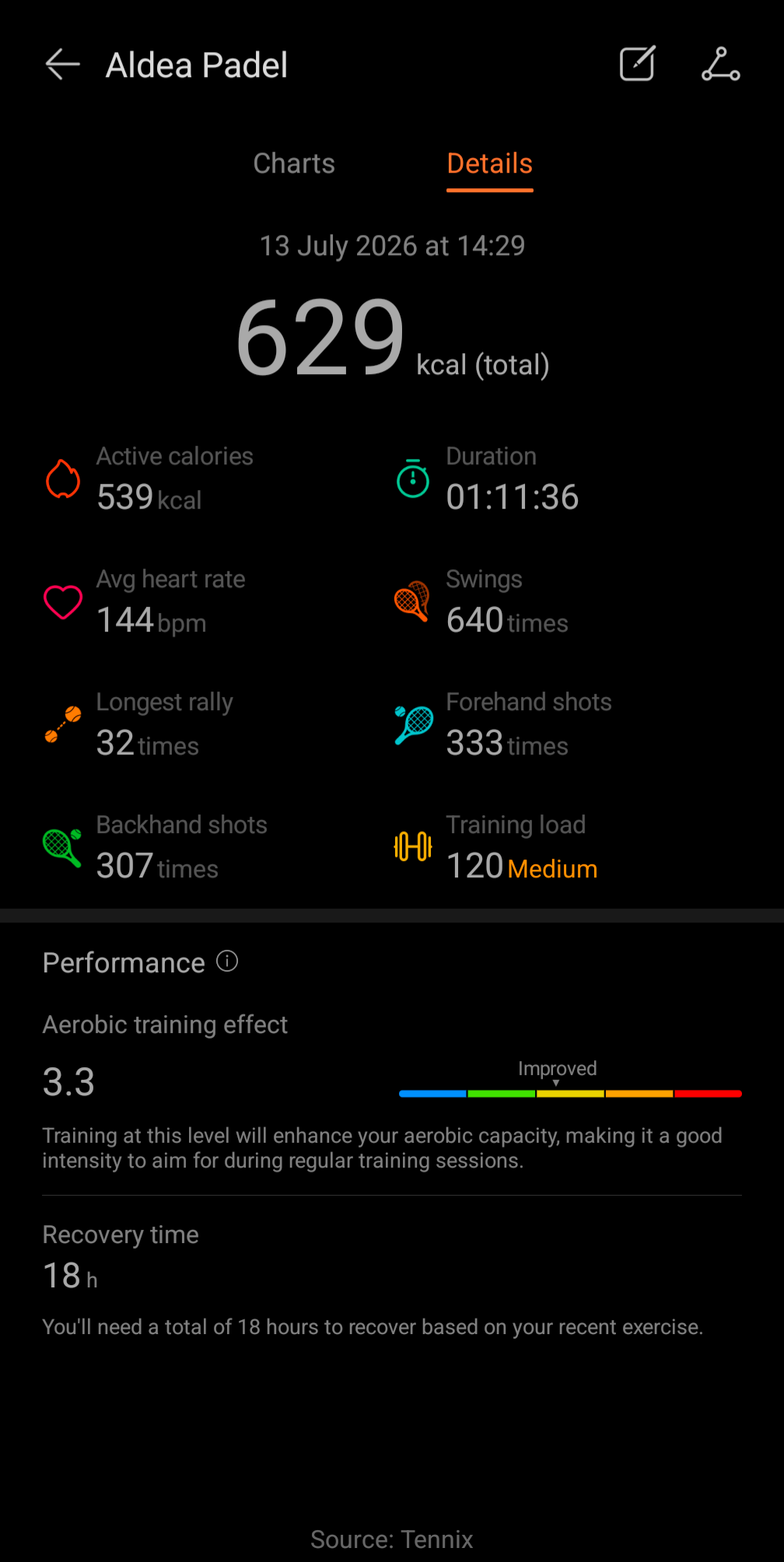
Here's what the Watch Fit 5 Pro and Tennix recorded for the full session:
- Duration: 1:11:36
- Total swings: 640
- Forehand shots: 333
- Backhand shots: 307
- Longest rally: 32 shots
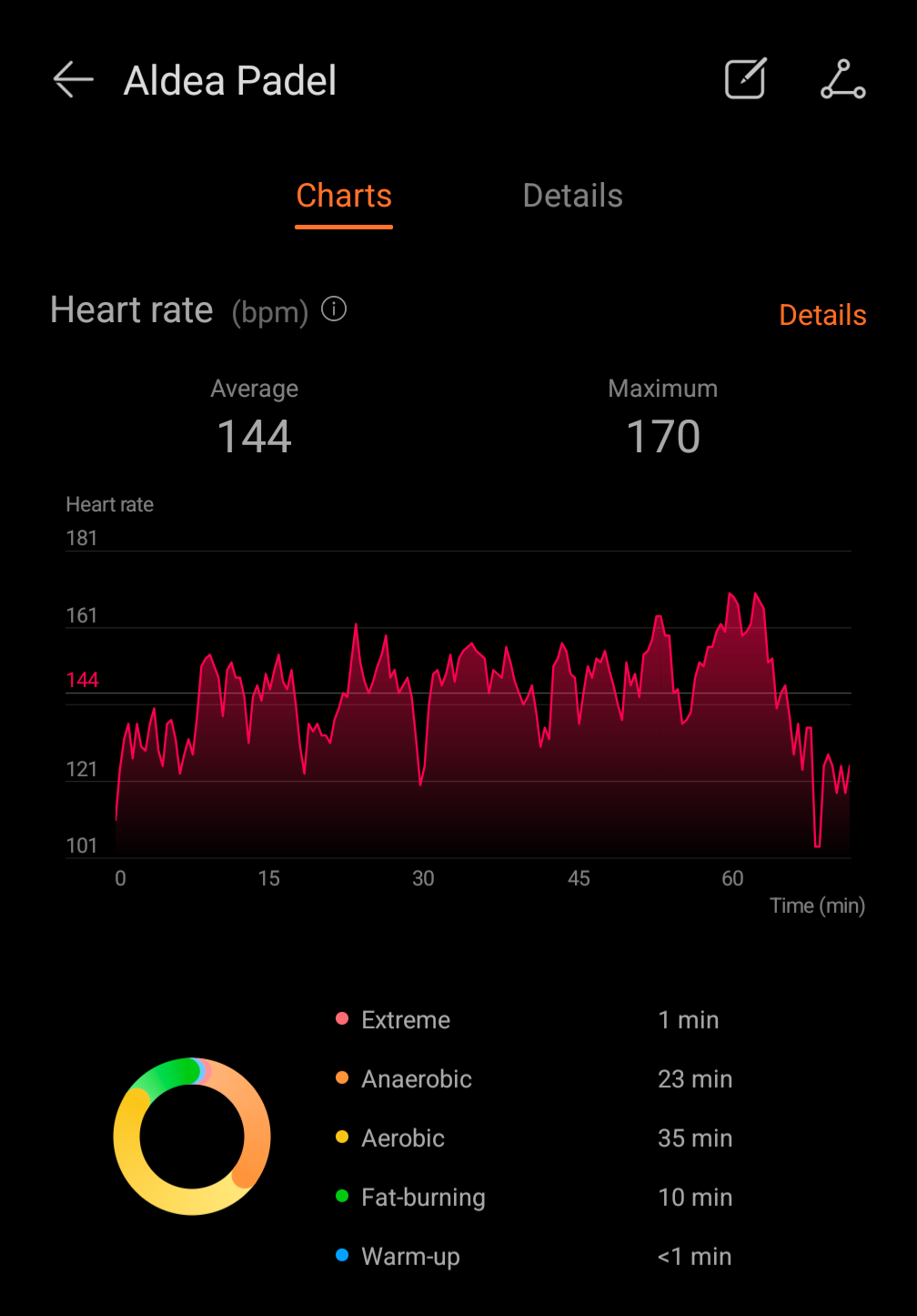
- Average heart rate: 144 bpm (max 170 bpm)
- Calories burned: 629 kcal total (539 active)
- Training load: 120, rated Medium
- Aerobic training effect: 3.3, flagged as an improving intensity
- Recovery time: 18 hours
The heart rate breakdown told its own story about how physical padel actually is. Of the session, 35 minutes sat in the aerobic zone and 23 minutes in anaerobic, with brief spikes into the extreme zone. That's a genuine training session, not a casual hit, and the data backed up how the last few games felt. The watch syncs your data from the watch to your Huawei Health phone app.
The watch syncs your data from the watch to your Huawei Health phone app.
The Accuracy Check
The number I trusted least going in was the longest rally count, since a fast, low-bouncing padel rally is exactly the kind of thing that could confuse shot-counting sensors built primarily around tennis mechanics. We counted our longest rally manually and landed on 32 shots. The watch's Tennix summary read 32 shots. Same number, no rounding, no near miss.
That single data point did more to convince me of the tracking's reliability than anything else in the session.
Room for Further Development
Court positioning. Tennix's current focus is squarely on stroke and event metrics, shot counts, rally length, forehand and backhand splits, rather than precise location tracking on court. That's a sensible scope for a first version. But Huawei already builds outdoor positioning into these watches through its Sunflower Positioning System, used for tracking routes on runs, rides and hikes. It's not hard to imagine that same underlying GPS and motion-sensing capability adapted to a much smaller, fixed space like a tennis or padel court, producing a genuine heatmap of where a player spends their time during a match. That would be a strong feature for the next evolution of the app, and the groundwork for it already exists elsewhere in Huawei's own ecosystem.
Racquet-specific shot types. The forehand and backhand split is accurate as far as it goes, but it's also where the tracking stops. Padel has its own signature shots, the bandeja and vibora among them, that Tennix doesn't currently register at all. Even the overhead smash, a shot tennis players will recognise, goes untracked.
Picking these up would likely require training the app's motion-recognition model on padel-specific swing data, since a bandeja's controlled, defensive wrist action and a vibora's sliced, aggressive strike move very differently through the accelerometer and gyroscope than a standard forehand or backhand.
That's a data and machine-learning problem more than a hardware one, since the sensors already on the wrist are picking up the motion, the app just isn't yet trained to label it correctly. A future version that distinguishes these would make the tennis and padel tracking more attractive and insightful for players of both sports.
Shot speed or spin data. Nothing in this session measured swing speed, which serious players will already expect from other wearables. Adding it for tennis or padel would round out the picture for players tracking real improvement over time, not just volume.
The Bigger Picture for Competitive Racquet Sports Players
What struck me most, sitting with this data after the match, is how naturally it could fit into a coaching setup rather than just a personal fitness log. Wear the watch through a practice session or a match, and the numbers are sitting there immediately afterward, ready to hand to a coach without any separate device or camera setup required. Shot counts, forehand-to-backhand ratio, heart rate zones, training load, all logged automatically and comparable session to session.
For a recreational player like me, that's a nice-to-have. For a pro tennis or padel player working with a coach day to day, it starts to look like something closer to a training tool. Rally length trending up over a block of sessions, or a forehand-to-backhand imbalance showing up consistently across matches, are the kind of patterns that are hard to track by memory or notes alone. If Huawei keeps refining accuracy and adds the positioning depth mentioned earlier, this has a real path toward being genuinely useful at a competitive level, not just a curiosity for club players.
The Verdict
For a first real padel outing, the Watch Fit 5 Pro and Tennix combination held up better than I expected. The dedicated Padel mode is a genuine design choice rather than an afterthought, the comfort held through a full hour of quick lateral movement, and the rally count matching our manual tally exactly is hard to argue with. The gaps are mostly around depth of data rather than accuracy of what's already there, which is a good problem for Huawei to have.
More broadly, this is the most capable racquet sports tracking I've come across on a wearable for tennis or padel. If Huawei keeps building it out, it has the potential to be a genuine differentiator in a smartwatch market where most brands are still competing on sleep scores and step counts. For players specifically drawn to tennis or padel, that's exactly the kind of feature that could pull them toward this watch over the more established names.
Jake Scudder
Journalist - topics of tennis