The US Open's New Partner Wants to Keep Fans "Engaged." The Data Says Engagement Is Part of the Problem.
"Tennis is one of the fastest-growing sports on Kalshi, with fans using our markets to understand what's happening throughout the tournament," Kalshi co-founder and CEO Tarek Mansour said, announcing the company's new deal as the US Open's first-ever Official Prediction Market Partner. USTA CEO Craig Tiley called it a way to "pioneer that next generation of fan engagement while ensuring the integrity of our sport."
Both quotes describe prediction markets as something that deepens a fan's connection to the game. I'd push back on that framing, because I've already reported on what that kind of engagement can look like at its worst.
What I Already Know About This
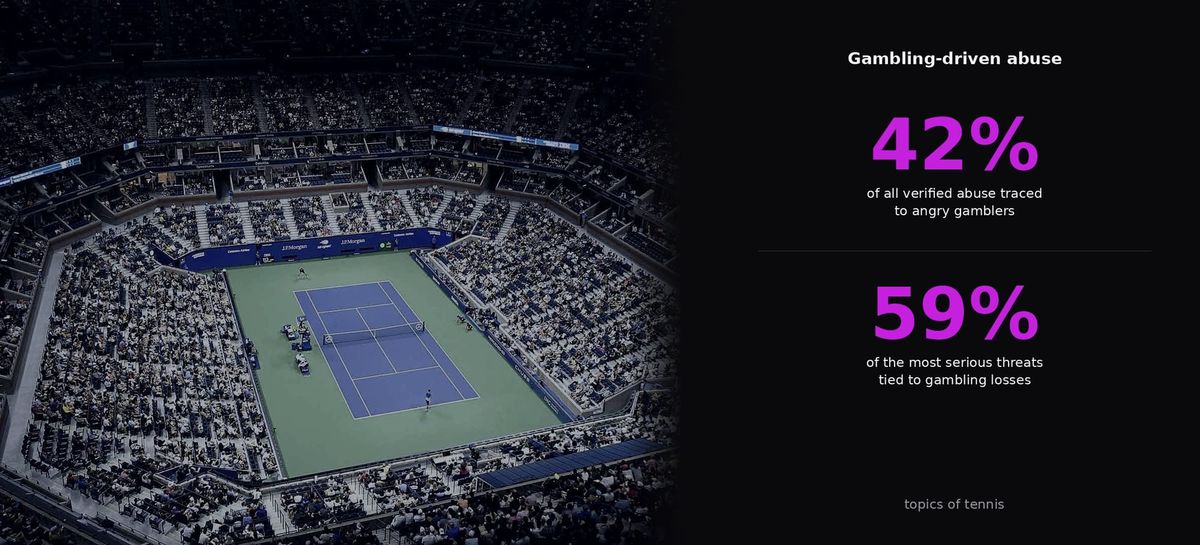
Earlier this tournament season, I covered the WTA's own data on gambling-driven abuse of players. Angry gamblers were found responsible for 42% of all verified abuse directed at players, and 59% of the most serious threats, the violent, sexual, and explicitly targeted ones. One case involved Hungarian player Panna Udvardy, who received death threats demanding she throw a match, accompanied by photos of her family and their home address. That's not a hypothetical risk. It already happened, this year, in this sport.
Prediction markets aren't identical to sportsbooks, Kalshi operates as a CFTC-regulated exchange, not a licensed bookmaker, and it draws that distinction carefully. But the underlying behavior a platform like this invites is the same one already driving abuse: people with real money riding on a specific outcome, watching a specific player, in real time. Calling that "engagement" isn't wrong, exactly. It's just an incomplete description of what engagement has already produced.
The Deal Itself Moved Unusually Fast
The USTA had reportedly planned to wait until 2027 or later before entering this kind of partnership. Tiley only became USTA CEO on July 20, and pushed to accelerate a deal into this year's tournament instead, finalized just before the main draw began on August 30. The rollout showed it. Kalshi wasn't listed among the US Open's official partners as of Sunday afternoon, even as a Kalshi blog post published that same day carried a disclaimer stating the company was "not affiliated" with the US Open. Whatever the reason for that inconsistency, it's not the sign of a partnership that had time to be carefully considered.
It's also exclusive. Under the agreement, rival prediction market platforms are barred from advertising anywhere at the tournament venue or across ESPN's broadcast coverage, a significant competitive lock-out for a sponsorship category that's still being fought over in court. Kalshi is currently disputing, state by state, whether its event contracts should be regulated as gambling at all, a Third Circuit ruling blocked New Jersey from regulating its sports contracts, while Nevada's enforcement was upheld the same week this deal was announced.
To Be Fair, There's a Real Safeguard Here
The USTA and Kalshi have built in genuine integrity measures worth acknowledging directly. Markets touching umpire decisions, player injuries, and code violations are restricted under the agreement, and Kalshi has a confidential data-sharing arrangement with the International Tennis Integrity Agency for real-time market surveillance, layered on top of the USTA's own monitoring and compliance enforcement. That's a more serious response than tennis's gambling problem has typically gotten.
But integrity monitoring for match-fixing risk and player safety from abusive fans are two different problems, and this framework is built for the first one. The US Open already runs Threat Matrix, Signify Group's AI abuse-detection system, specifically to catch harassment directed at players, and it's the tool that's actually been catching the gambling-driven abuse in the first place. Kalshi's announcement doesn't reference it. Two systems, watching for two different kinds of harm, and only one of them is mentioned in a partnership specifically about deepening fans' financial stake in match outcomes.
Fans understanding "what's happening throughout the tournament" is a fine goal. It's just not the whole story of what happens when tennis and real-money outcomes get closer together, and the US Open's own announcement doesn't mention the part we already know.
Jake Scudder
Journalist – topics of tennis